I live on a lake and wanted to spray the back yard but I’m concerned about the fish. Will the treatment runoff to the water? I see you have an alternate option the exempt liquid. Says that its safe for use over water so I might get that instead. Please let me know the guidelines on this. I tried reading through the label but it was confusing.
So first, the labels can be confusing and in general, it’s always best to ask us first if you have concerns regarding a sensitive area you intend on treating. Every situation is unique BUT there are usually clear guidelines on the label. If you refer us to the section that gives you cause for alarm, let us know. We generally understand labels quite well and if we don’t, we’ll find out quickly from the manufacturer.
So in this case, lets make sure we’re both discussing the same thing. This is important because there are differences when discussing runoff vs leaching (also referred to translocation).
Runoff will happen when spraying and essentially is when “too much” is being sprayed leading to puddling. These puddles can then trickle to sensitive areas – especially if you’re treating along a steep incline which leads to water.
So if you’re spraying and getting runoff, stop treating. Let it soak in and come back again if you have more that needs to be applied to get the labeled rate. Runoff is a big waste of mixed product and should be avoided. Now if the land/dirt/soil around a home is where it’s accumulating and the land is flat so the runoff stays there, you’re probably okay. This is especially true if you are treating for something like springtails or some other ground dwelling pest.
But if you’re spraying your land and it slopes toward a stream or some other body of water? You’ll need to avoid runoff AND keep an untreated “buffer” zone to allow for both unseen runoff AND leaching.
So what exactly is leaching? Also known as translocation, this is when an active ingredient can get relocated to other areas. This usually happens following a flood or heavy rainfall but is also possible if treated soil is shoveled up and carried to a new location (this last option is very rare).
So to summarize, RUNOFF can happen if your “over” spray and create puddles of mixed solution. This is typically possible for about 12-24 hours after treatments have been applied. But as the solution dries, it will be “locking in” to the soil, plants, structures, etc. and within a day, be hard to relocate. And this is when LEACHING may occur.
Leaching is not nearly as significant with our products compared to runoff. Once in place, soil treatments may move a few inches if there is a lot of water introduced. But they won’t move far and when used at the prescribed rates, present little hazard of making their way to water or other sensitive areas.
ALL THAT SAID, FOLLOW THESE GUIDELINES FOR ALL OUTSIDE TREATMENTS TO BE SAFE!
1) Don’t treat if it’s windy. And this is true for every one even if you aren’t around water. We consider a constant wind of 10 mph to be the cutoff. Wind can “carry” a treatment so don’t spray when there is constant wind or even if it’s gusty. Wait till early morning or when we generally recommend treating, around dusk. This is usually when winds lay down but again, pay attention to local wind rates and proceed when its under 10 mph.
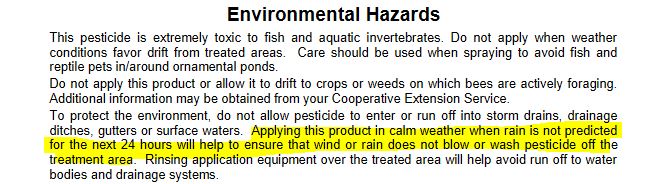
2) Do not treat if rain is expected in the next 24 hours. Excessive water from rain falling on a freshly treated yard, may literally carry off your treatment leading to waste or even worse, possible water contamination if you’re property borders any body of water. The good news is that our concentrates will “lock in” place within 12-24 hours and so normal rain fall days later won’t matter. The treatment would have had plenty of time to get secured to the dirt and plants or structure sprayed and won’t be affected. We recommend this for pretty much everyone, so even if you don’t have water close by, don’t spray if rain is expected. We only have a few products which have this printed on their label and here is a section from one that includes this guideline:
3) Don’t over spray to the point of runoff that leads to waste. Again, this pertains to everyone.
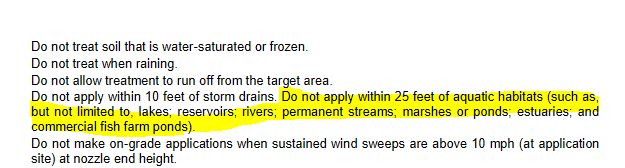
4) Keep at least a 25 foot “buffer zone” of untreated land between where you spray and where the water begins. We recommend 50 feet if the land is sloped 45 degrees or more. This statement can be found on a few of our products and specifically pertains to anyone who is treating their property where it’s close to water (lake, river, estuary, pond). We’re not aware of this restriction for “ocean front” property but we recommend following the guideline anyway. Here’s another example of how it might be phrased on the label:
In summary, follow these guidelines if you reside alongside any body of water. And always refer to the label first to be sure these values (the ones above) are listed on the product you intend on using. We know the products we carry and the guidelines above are the most extreme and only apply to a few of our concentrates. Many we have do not have any warnings and if any at all, to a lesser degree.
So to summarize, make sure no rain is predicted for at least 24 hours after making a treatment and if you leave at least 25 feet of untreated area between your yard and a body of water, there will be no risk of contamination using our current products.
Lastly, if you’re still not 100% confident proceeding, consider getting some PEST XEMPT GRANULES or PEST XEMPT CONCENTRATE. Both are made with all natural essential oils and can be safely used right up to water without any hazard presented to fish or other wildlife.
Leave a Reply